Showing posts with label haiti. Show all posts

Saturday, September 24, 2011

Journalism in Haiti - Thoughts and Sources

Journalistic coverage of Haiti has always been a quagmire of mixed perceptions. In some ways, this seems to go back to racially charged stigma that has been attached to Haiti since it's independence in 1804. There are also plenty of clichés that for anyone who follows Haiti in the international press, are the definition of banality (see here for a brilliant satire of this phenomenon http://tinyurl.com/2aseyah).

While I have always found a gap between the reality on the ground and journalistic coverage, there are a few very accurate journalists and sources for news on Haiti.


Ansel Herz is a freelance journalist living and working in Port-au-Prince. You can read his updates at www.mediahacker.org


I'm also a fan of this blog: http://goldyard.tumblr.com/


In terms of more general news, Al-Jazeera (http://english.aljazeera.net) is pretty accurate, especially in their post-quake coverage, which was recently summarized in a documentary "After the Quake" and can be found here... http://tinyurl.com/5u4kglr


And I would kick myself if I did not include Mark Weisbrot, who is the Co-Director of the Center for Economic and Policy Research and is frequently featured in the Guardian.


http://www.guardian.co.uk/profile/markweisbrot


For a good summary of general Caribbean News:

http://www.caribjournal.com/


I’ll certainly add sources as I come across them...

Sunday, July 24, 2011

SOIL in the Los Angeles times: Cholera is still a threat


http://www.latimes.com/news/nationworld/world/la-fg-haiti-cholera-20110724,0,4930249.story

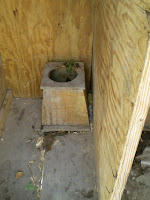
This article from the LA Times discusses Haiti's ongoing struggle with Cholera. SOIL's Executive Director Dr. Sasha Kramer (my boss!), discusses the issue of toilets that have been abandoned or neglected by the international organizations that constructed them. It is an unfortunately common site in many camps to see to
ilets that have clearly been long neglected or altogether abandoned. Many are simply large open bins of human waste that sit below a plywood frame. Doors and toilet seats are often missing and in some cases there is no stall and residents have no choice but to do their business entirely exposed. Though as the article says the neglect and abandonment of these toilets increases the risk for the spread of cholera, it is on a more simple level, an abomination of the simplest ideas of human dignity.

Below is a photo of one of the abandoned toilets discussed above. This particular toilet had no doors, a missing wall, no seat and the catchment area below was simply an open basin full nearly to the brim with human waste. As we pulled away, we passed three young girls holding toilet paper mounting the stairs. They deserve better.


Thursday, July 21, 2011

Week 1 in Haiti - Update from Port-au-Prince

It’s been a long time since I’ve updated but as some of you already know, I’m writing you now from Haiti, having started working with the organization Sustainable Organic Integrated Livelihoods (SOIL) in Port-au-Prince.

Now that I think about it, I should probably take a step back and explain the past few months. Last time I posted would have been early November and much has happened since then!

What I suppose is technically most important is that I graduated, completing my Masters of Arts in Latin American and Caribbean Studies with a concentration in Environmental Studies (shout out to the Latin American and Caribbean Center at FIU). Academically, the largest part of this graduating semester was of course my thesis, for which I completed field research last summer in northern Haiti. This past semester was spent writing, editing, writing and finally getting the document to an academically acceptable place for my committee. The final product, entitled Community Environmental Preservation Initiatives in Borgne, Haiti can be found here http://digitalcommons.fiu.edu/etd/403/. Since I highly doubt that you’ll read the whole thing, I have pasted the abstract at the end of this post. Though many other non-professional/academic things have happened (mainly my robust interest in Cuban flowers), I will move on to my current position with SOIL.

Though I’ve written about SOIL previously, I will recap their work briefly but I of course encourage you to check out their website at www.oursoil.org. A new website is on its way soon but for now, there is much valuable information to be found there.

My own summary of SOIL and their work goes something like this…

Often times in developing countries, the basic necessities that we take for granted in the United States are lacking or altogether absent. This is the very unfortunate case in Haiti, where a large percentage of the population lacks access to public sanitation (i.e. toilets). Though this is especially true in the countryside, it is also true in some of Haiti’s poorest communities, where even before the earthquake there was no proper way to treat human waste. Since the earthquake, with such a large number of people displaced from their homes and living in tent communities, the public sanitation situation grew even more serious. While pit latrines or other types of toilets exist, there is no way for waste to be treated properly and so it is collected in large tanker trucks, hauled out to an area near the city dump and emptied into what are essentially ponds full of human waste. (Because of the graphic nature I won’t post images but this youtube video sums up the situation pretty well: http://bit.ly/nahpbT ).

--> ENTER S.O.I.L.

In ameliorating this problem, SOIL employs a unique type of toilet that takes human waste and turns it into nutrient rich fertilizer. By separating the urine (which is sterile and can safely be diverted into an underground gravel pit ground with no health hazard) and the feces, which is mixed with bagesse (a type of mulch that is a byproduct of the sugar cane that is used to make rum, in this case its from the makers of Barbancourt rum), the waste becomes an easily compostable damp mulch (that was a very long sentence but roll with it please…). The mulch is then taken to a separate compost site where it is concentrated in large bins for a few months. Concentrating a large amount of compost allows for enough heat generation kills too the harmful pathogens present within human waste (including Cholera). Though compost piles generally generate a great deal of heat, it’s typically even easier to generate heat in Haiti’s sub-tropical environment (I can personally attest to that as the sweat drips down my forehead while I write this). This New York Times video is a bit old but sums things up well…

http://www.youtube.com/watch?v=Xb9AiHkhg5o

Finally, here is an article about our Executive Director Dr. Sasha Kramer, who was named one of National Geographic’s emerging explorers.

http://www.nationalgeographic.com/field/explorers/sasha-kramer/

I encourage you to check out their very important work and consider supporting SOIL in any way you are able. I certainly could not be more proud to work for such a fantastic organization. As a sort of cliff hanger I’ll leave a few of SOIL’s other amazing qualities for future posts. Let’s just say for now though that Kreyòl is the name of the game…

So, on a slightly more personal note, I can imagine that some of the family and friends network are probably wondering: “What are Craig’s living conditions in Port-au-Prince?” Well, if inquiring minds want to know, I’ll tell you…

SOIL has a very lovely two-story house that they rent in the Delmas neighborhood of Port-au-Prince. The upstairs serves as living quarters for some of the staff and the downstairs is a kitchen and the principal office area. Of course just about every nook and cranny is covered with potted plants of some kind (were a green organization!). The house has plumbing (water is pumped up to a tank on the roof from a well) and a few flush toilets but most of us prefer to use the household dry-compost toilet which is a much smaller version of the toilets described above.

With this model, a 5 gallon bucket handles the solid waste/bagesse mixture with the urine separated into a smaller container that is meant to be emptied daily. The house itself has very nice tile floors , many large windows and a huge wooden stairwell that curves up through the center of the house.

I will have more updates soon but it’s already been a long week and quite frankly the heat is killing me…

Please find the abstract of my thesis below.

All the best from Port-au-Prince,

Craig

___________________________________

In examining the opportunities that lie within the larger context of Haitian development efforts, mending the strained environment upon which Haiti’s fragile rural agricultural sector depends must be a priority. Though related to other pieces of the Haitian reconstruction puzzle, the question of mending the Haitian environment comes down largely to the best way trees can be incorporated into Haiti’s existing agricultural systems. With this in mind, the purpose of this thesis was to complete an analysis of the work and practices of the community organizations of Borgne, Haiti. The organizations of Borgne have mobilized toward environmental development and the preservation of remaining natural resources through a community-wide tree-planting initiative that provides thousands of trees per year to local residents. Beyond an ethnographic assessment, this thesis explores greater implications of the project as a grassroots development model that may potentially be replicated by other communities and organizations throughout Haiti. Field research was completed on site in Borgne in the summer months of 2010. The primary methods employed in data collection were Participatory Action Research and semi-structured interviewing.

Sunday, November 21, 2010

Abstract: Haitian Studies Association Conference at Brown University - Nov. 11-13

Environmental Initiatives on the Community Level: The Case of Borgne, Haiti

In examining the opportunities that lie within the larger context of Haitian reconstruction efforts, mending the strained environment upon which Haiti’s fragile rural agricultural sector depends must be a priority. Though related to other pieces of the Haitian reconstruction puzzle, the question of mending the Haitian environment comes down largely to the best way trees can be incorporated into Haiti’s existing agricultural systems. It can safely be assumed that just as thousands of trees have been planted in Haiti in the past, thousands more will be planted in the future by NGOs, International Organizations and perhaps even Haitian government agencies.

While the decades long absence of any kind of positive and stable government presence has created a “republic of foreign NGOs” that provide the bulk of Haiti’s essential services, it has also had lasting and potentially positive impact on rural civil society. Though born out of a need to overcome challenges in the absence of government help, the presence of dynamic community level organizations in Haiti presents the opportunity for both governmental and nongovernmental organizations to engage and reflect a more appropriate approach to reconstruction and development initiatives in Haiti. Though “grassroots” in itself has become a controversial buzzword on the development scene, it is evident that rural Haitians are both willing and capable of mobilizing themselves toward a cause (Smith 2001). It is of little surprise then that some of these organizations have moved beyond the often cited “konbit” (a Kreyòl word describing collective farm work) to larger endeavors—such as tree planting, environmental education and erosion control.

The importance of the post-earthquake opportunity for a paradigm shift cannot be overstated as engaging rural community organizations in reconstruction efforts would represent bypassing the rigid stratum that have long plagued Haitian society and historically hindered development. The purpose of this paper then is to examine and assess the unique environmental initiatives undertaken by the community organizations of Borgne: the Movement for the Integral Development of Borgne and the Gwoupman Peasant Organization of Kot de Fer. These organizations have mobilized toward environmental development through the construction of nurseries that provide trees to community plot holders, the systematic monitoring of those trees provided by the organizations and educational sessions for community members on how to prevent further damage to their land.

Beyond an ethnographic assessment, the primary question to be answered in this paper is whether the model incorporated by the organizations of Borgne may be successfully scaled up to other communities throughout rural Haiti. Further, how can this important work in environmental reconstruction and development be supported by other development entities both governmental and nongovernmental?

Field research will be completed in June and July 2010 and will use multiple research methodologies. The primary methods to be employed in data collection will be Participatory Action Research, semi-structured interviewing and limited surveying.

This presentation will be an interactive lecture that will invite some audience participation and will use a Powerpoint presentation as a visual aid to present photos, diagrams and statistics.

References:

Smith, Jennie M. When the Hands are Many. Ithaca, New York. Cornell University Press, 2001.

Abstract: Given the desperate need to mend Haiti’s environment, which has been struggling for decades under the pressures of a burgeoning population, this presentation will examine the environmental initiatives of the community organizations of Borgne, Haiti, and their potential as a model for future environmental reconstruction and development initiatives.

Monday, May 31, 2010

Greatest Goal in US Soccer History: Scored by a Haitian Immigrant


ESPNs Outside the lines explores the greatest goal in US Soccer history and the tragic fate of the Haitian immigrant who scored it.

Monday, May 3, 2010

January 5 - a more typical day...

In keeping with a solid mix of entries, I want to include one of our more typical days. January 5 was the day after we arrived in Cap-Haitien.

After a restful and rock hard sleep, we woke up and enjoyed a wonderful breakfast. The bananas and bread were fresh and the coffee was delicious. Taking advantage of the sunshine, we piled into the SOIL truck and headed out to the technology center in Milot. After one of the nice but bumpy rides that characterize Haitian transportation, we dismounted outside of a group houses. We were welcomed by an old dell computer and a smiling gentleman who was working very hard carving a large toilet basin out of clay. I stood amazed as Sasha and Sarah explained the various designs and materials that were used in the production of the toilet bowl. The clay could be found locally. Surely they could have imported toilet bowls from the US, but this was an ethical operation that was not just about providing a toilet but also about empowering communities. Leaving the man to his work, Sasha showed us the toilet out back. We took turns stepping inside the toilet and having a look around. I was blown away at the simple yet brilliant innovation. It was as if the cycle was complete: food went from the field, to the human stomach, to the toilet, to the compost heap and back onto the field to enrich the next round of crops. To examine this cycle in its totality, we walked to an additional compost site and through the local fields and gardens. I noted the presence of banana trees through the potato plots…was this planned or by happenstance? I didn’t have too long to think as we continued our jaunt through the community to a dense plot of trees. How refreshing to see veritable forest in Haiti! Internally, I beamed with excitement and began my own mental journey through history—imagining the entire island covered with lush forest. This intellectual indulgence only continued with our arrival at a massive tree which was rumored to have been around since before the revolution. Sasha explained the role of the tree and its giant roots as a political meeting place, but the presence of pots around the base of the tree also had other religious implications. I began to get the eeriest sense and recalled Amy Wilentz’s commentary about Haitians being a people that “walk in history.” The local fellow who was walking us around led everyone over to a large hollow tree, to whom he spoke or prayed loudly. Hanging in back with a few of the SOL gang, I asked them if there were in “lwa” around and they just smiled and laughed. “Is he talking to Bondye?” I asked. They laughed again. Our conversation continued and I joked with them that I wasn’t going into any tree you had to talk to, especially considering how close we were to Bwa Kayiman. “You know your history!” they said to me through their laughter. Just then from the other side of the giant tree, Jack asked about the presence of snakes. While he waited for an answer, he looked down toward his feet and saw a very large snake skin. I’m not typically a religious or mystical guy, but there was just too much going on here to ignore. The two fellows I was with also took a much more serious demeanor. What a strange thing I thought aloud…This is one blan that will not be ignoring Haiti’s rich religious heritage—vodou or otherwise!

Thursday, April 1, 2010

The Story of Haiti and How You Can Help - (Take 2)

In looking back this probably should have been my first post as it was what first inspired this blog. Since I wrote this SOIL has been working in Port-au-Prince to try to alleviate the dire need for toilets and proper waste removal. I also believe they have started their first compost site in/around Port-au-Prince. You can check for updates on the SOIL website at www.oursoil.org They are doing great work.

I will have another post up shortly with a few thoughts on development efforts in Haiti.

_____________________________________________________________

Those of you that know me well (and even those of you with whom I have not been in recent contact) know that at some point in the last few years I dove headlong into the rocky, treacherous and beautiful cause that is Haiti. Haiti has in so many ways become my life. It consumes my mind through research, my mouth through a fellowship to learn its language and my heart through its very existence.

To paraphrase Amy Wilentz, who has written extensively on this distinct phenomenon: Haiti is not a place into which one can take a sample or half-heartedly commit, rather Haiti grabs you with its giant claws and doesn’t let go. You feel as if it is grabbing you for a reason, like it has been waiting for you—and when you find out it hasn’t, you thrive on its rejection.

Though most are familiar with Haiti’s problems (including the international press, which has long painted Haiti as a dangerous and savage outcast), few know it’s deep and hardy roots, which stand fast as a base for the tree of liberty in the Western hemisphere. Haiti was the second country (behind the U.S.), to garner independence from its European colonizer. The legacy of that colonial power (the French, who called their colony “Saint-Domingue”) is one of raw brutality, torture and bloody sweat. As we labor to help Haiti in the wake of the 7.1 magnitude earthquake I believe we should know and understand the story of these people.

French plantation owners committed unspeakable atrocities on their enslaved West African imports—unspeakable to the point that most of the female population was sterile, or was worked to death before being able to reproduce. It was quite frankly cheaper to import new slaves than take care of those already in the colony. Imported slaves developed a common language that was primarily a mix of French and West African languages. Given this tumultuous origin, it is no surprise then that the language that emerged—Haitian Kreyol—has long been called “the language of survival.” Though rumblings of resistance were previously met with harsh blows, in 1791 the slave populations of northern Saint-Domingue rose up under the leadership of Voudou Spiritual Leader Dutty Boukman (or “Book-man”, so called for his reading abilities). Following a ritual at Bois Caiman, the slaves began a thirteen year rebellion against their French oppressors. Initially armed with nothing more than long machetes used for cutting sugar cane, the slaves rapidly began to organize under the leadership of General Toussaint Louverture, an educated former slave and devout Catholic. Though Louverture was captured, his armies eventually defeated French forces under the leadership of General Jean-Jacques Dessalines.

On January 1, 1804 just months after dealing the French their final blow at the battle of Vertieres, Dessalines restored the name “Ayiti” or “Land of High Mountains” in the native Taino language and infamously declared that in defeating the French he had “avenged the new world.”

Truly the forces of good defeated those of the purest evil, that is what a successful slave rebellion represents, good over evil, right over wrong, liberation from chains and oppression. Despite this polished and hardened moral victory Haiti was made a pariah by the international community. The United States did not recognize Haiti for sixty years after its independence and France refused to trade with its former colony until the young nation agreed to pay today’s equivalent of $20 billion in reparations for property lost during the Haitian revolution. It was of course that $20 billion that forced Haiti into a cycle of debt and deforestation (much of the islands tropical timber was felled and sold to raise money to pay reparations).

Since its existence Haiti has been punished for its success—punished for being on the side of good in defeating evil. Call it racism, call it jealousy, call it ignorance or call it disrespect, the fact remains that the victory and legacy of Haiti and the Haitian people still represent the ultimate moral triumph of any age and any place on earth. Good defeating evil is rarely so transparent. Despite decades of challenges that range from environmental degradation to political instability to outright occupation by foreign powers (the U.S. occupied Haiti for 19 years from 1915-1934 to “protect American and foreign interests”), this moral victory endures. Despite the stereotypes of voudou practitioners, the boats of refugees that sink under the weight of desperate souls trying for a better life, and the yearly devastating hurricanes, this victory endures and lives within the soul of each Haitian.

Thus it should be with great anticipation that we seize the opportunity to be a part of the cause of the Haitian people, which since the beginning has been the cause of good over evil.

Everyone wants to know how to help, and not just for the now but for the future as well. I am fortunate enough to have traveled to Haiti three times, and was present on the island when the latest disaster struck. I believe I have found an organization that is employing effective and innovative solutions to common problems. The program is called Sustainable Organic Integrated Livelihood (S.O.I.L.) and to speak candidly, they build toilets.

So you may be asking yourself how can I be advocating for the building of toilets when the capital city lays in ruins? My logic is plain and direct, this organization has developed a method to change human waste into nutrient rich compost, all the while teaching basic public health and enriching Haiti’s topsoil, which is severely depleted after years of deforestation . Improper sanitation breeds disease, drains resources and prevents community growth. Further, massive deforestation has created a cyclical problem leaving Haiti vulnerable to Caribbean hurricanes, mudslides, and desertification so severe that large crop yields are hard to come by, which is what forces Haiti to depend largely on imported food.
Through this organization’s work they have reached into the villages in northern Haiti and developed partnerships with the local people and organizations. They have been doing the on-the-ground work that has taught them where the needs of the people really are for years, and now that chaos has erupted in the wake of the earthquake they are well positioned to, in the short term get supplies to the people that need them most. They are small, agile, thrifty and their long-term connection to the people of Haiti will not fade after the cameras and microphones of the world media are shut off. Perhaps most importantly, I have witnessed firsthand that this organization operates under a very basic ethos, “Tout Moun Se Moun” or “All People are People.” They are well connected to both American and Haitian organizations that are on the ground doing disaster relief now, and they will continue their valuable work over the long term.

As I close I must present the awkward request for your charity. At the very least I urge you to remember the story of Haiti, their triumph over enslavement, their fight for freedom and recognize that they deserve liberty from the narrative that paints them as primitive, uncivilized or looking for a handout. They share all of humanity’s desire to sing in the glory of self sustaining sovereignty. This is a story that must be told so please correct misinformation, and fight ignorance of Haiti’s story. If you can, I urge you to give to the organization S.O.I.L. by going to www.oursoil.org (you can also follow one of the directors blogs, Dr. Sasha Kramer is currently working in Port-au-Prince). I pledge that from what I have seen, this group will continue their valuable work, allowing Haiti to move beyond survival to a place where they can prosper.

I urge you to give both now and in the future.

Participate in the cause of good, invest in Haiti.

Tuesday, March 23, 2010

The Total Environment

Though usually harm to the environment and its effect on human populations seems gradual and distant, the tragic reality is that in many parts of the developing world, the environment is not a distant concept but something dealt with and depended on for daily survival. The traditional concept of “nature” or “conservation” in the US is a large, undeveloped area with lots and lots of trees—and no people. Though volumes exist on the evolution of the environmental movement and the debates between conservation and poverty alleviation (most people that inhabit forests are generally poor, booting them out to “conserve” only disrupts their livelihood more), the fact is that the connections between human and environment are exponential and cannot be ignored. These connections are tragically apparent in Haiti, where environmental degradation is inherently tied to degenerated soil quality and a near total absence of trees. Because only 2% of Haiti’s tree cover remains, deforestation has caused massive erosion and soil degeneration. Subsequently poor agricultural yields hinder the nation’s ability to produce enough food to feed itself (though US rice imports flooding the market has not helped either). Combining these conditions with peasant demands for energy—which comes in the form of wood charcoal—threatens the Haitian environment’s capacity to sustain a burgeoning population. While Haiti may never be the lush forested island it once was, strategically planted trees and hedgerows may serve as erosion barriers to halt what in some cases can be a rather harsh reminder that the effects of environmental degradation are not always slow or gradual. A recent mudslide in Cap Haitien, which crashed into a school and took the lives of four students, serves as a harsh reminder that in Haiti the environment is not fading slowly on a distant horizon but is crumbling away on a daily basis, threatening not only Haiti’s agricultural economy, but her citizens too.

http://www.miamiherald.com/2010/02/16/1482002/mudslides-hit-school-four-students.html


*The city of Cap-Haitien is built right into the mountains surrounding the city

Friday, March 5, 2010

Introduction


As you can read over to the right, my name is Craig and I am currently a graduate student in the Latin American and Caribbean Center at FIU in Miami. I completed my undergraduate work in the Whitehead School of Diplomacy at Seton Hall University in South Orange, New Jersey. I’ve started this blog as a platform upon which to build. Though I hope to document my own story as it happens, my principal concern will be to weave my own experiences into the epic landscape of Haiti and its beautiful people. As I will likely discuss in greater detail in later posts, the cause of Haiti is the cause of good. The very existence of the Haitian republic represents the triumph of slave over master –of right over wrong and good over evil. As you can guess by the title of this humble little blog my focus is on trees and the Haitian environment. Deforestation and the cycle of poverty, as well as reforestation efforts (for lack of better technical terminology) are the general focus of my research. I look forward to whatever lays ahead and to employing this blog as an outlet for recording my experiences. Check back for updates and please feel free to post your own comments and feedback!